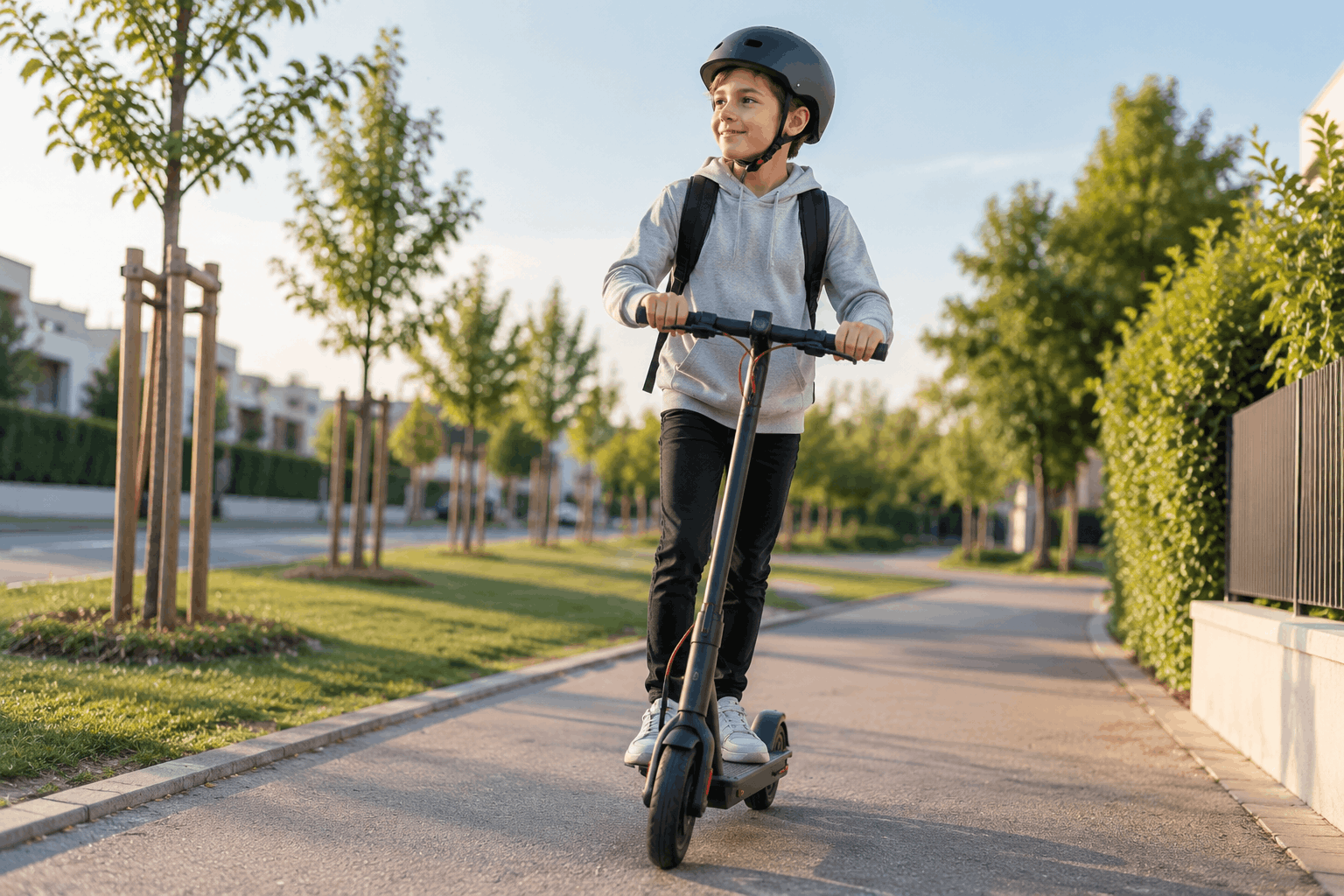
If you are wondering can a 12 year old ride an electric scooter in the UK, the answer depends on where the scooter is being used. A 12-year-old cannot legally ride a privately owned electric scooter on UK public roads, pavements or other public land. Privately owned e-scooters can currently only be used on private land with the landowner’s permission. A 12-year-old also cannot use one of the government-approved rental e-scooters on public roads. Riders using official rental schemes must have an appropriate full or provisional driving licence, which rules out a 12-year-old. That does not mean a child can never use an electric scooter. There is an important distinction between riding on public land and using one on suitable private property. Parents also need to consider speed, scooter size, battery safety and the child’s ability to control the scooter safely.
What Are the UK Laws on Electric Scooters?
Electric scooters can look similar to ordinary push scooters, but the law treats them very differently. Privately owned e-scooters are currently classed as powered transporters. They cannot legally be ridden on public roads, pavements or in public places such as parks. The government states that privately owned e-scooters may only be ridden on private land with permission from the landowner. This restriction applies regardless of whether the rider is an adult or a child. In other words, buying an electric scooter does not automatically give someone the right to ride it on the street.
Can a 12 Year Old Ride an Electric Scooter on the Pavement?
No. A 12-year-old cannot legally ride a privately owned electric scooter on a public pavement in the UK. In fact, adults cannot legally ride privately owned e-scooters on public pavements either under the current rules. This is an important point because parents may assume the pavement is the safest place for a child to ride. From a legal perspective, however, privately owned e-scooters cannot simply be treated like children’s push scooters. The presence of a motor changes their legal status.
Can a 12 Year Old Ride an Electric Scooter on the Road?
A privately owned electric scooter cannot legally be ridden on public roads under the current UK rules, whether the rider is 12, 16 or an adult. There is an exception for approved rental e-scooters operating within official trial schemes in England. Those rental scooters can be used on permitted roads and cycle lanes within trial areas, subject to the scheme’s rules. They cannot be ridden on pavements or motorways.
However, that exception does not allow a 12-year-old to use them.
What About Rental E-Scooters?
Rental e-scooters are where the rules can become confusing.
Official rental e-scooters operate in selected trial areas in England. The trials have been extended and are currently due to run until May 2028. To use a rental e-scooter, a rider must have the required driving licence entitlement. Government guidance states that users need either a full or provisional UK driving licence with the appropriate entitlement.
A 12-year-old cannot meet that requirement.
Parents should therefore never unlock a rental scooter through their own account and allow a child to ride it. Government guidance for rental operators specifically identifies parents unlocking e-scooters for children as a form of illegal use that schemes should work to reduce.
Where Can a 12 Year Old Legally Ride an Electric Scooter?
For a privately owned electric scooter, the straightforward option is private land with the landowner’s permission. That might include a genuinely private property or another suitable privately owned space where the owner has specifically allowed its use.
Simply being away from traffic does not automatically make somewhere private land. A pavement, public park or public cycle route should not be assumed to be legal simply because it appears safe or quiet. Parents should establish who owns or controls the land before allowing a child to ride there.
Are Children’s Electric Scooters Different?
Electric scooters marketed specifically for children may be smaller, lighter and slower than adult commuter models. Some have lower maximum speeds, smaller motors and adjustable handlebars. Those design differences can make a children’s scooter more appropriate for supervised recreational use, but they do not create a general exemption from the rules governing where privately owned powered scooters can be used.
A product being labelled a “kids‘ electric scooter” does not mean it is automatically legal for a child to ride on a public pavement or road. This is an important distinction when shopping online. Product suitability and road legality are two separate questions.
What Speed Is Suitable for a 12-Year-Old?
There is no single speed that is appropriate for every 12-year-old. Experience, coordination, physical size, the scooter’s design and the riding environment all matter. For private-land recreational riding, parents should prioritise a scooter designed specifically for the child’s age, height and weight rather than buying an adult commuter model simply because it offers better performance.
Higher speed is rarely an advantage for a young rider. A scooter that accelerates gently and allows the rider to maintain comfortable control is generally more sensible than one designed primarily around top speed. Some children’s electric scooters include selectable riding modes or restricted speeds. These features can help a young rider become familiar with acceleration, braking and steering gradually.
Why Adult Electric Scooters May Not Be Suitable for Children
An adult electric scooter can be considerably heavier and faster than a model designed for younger riders. Weight matters because a child needs to be able to control the scooter during turns, braking and low-speed manoeuvres. A heavy scooter may also be difficult for them to move safely if it falls over. Handlebar height and deck dimensions also affect control. A scooter designed around an adult rider’s proportions may put a child in an uncomfortable or unstable riding position. Braking is another consideration. A child needs to understand how quickly the scooter responds and how much distance is required to stop. For these reasons, parents should not judge suitability solely by whether a child is physically capable of standing on and operating the scooter.
Safety Considerations for Young E-Scooter Riders
Even when a 12-year-old is riding legally on private land, sensible safety precautions remain important. A properly fitted cycle helmet is a sensible starting point. Knee and elbow protection can also be useful, particularly while a child is learning. The riding area should be flat, open and free from traffic, pedestrians, steep slopes, loose gravel and unnecessary obstacles. Children should also learn how the scooter behaves before building up speed. That includes understanding acceleration, controlled braking, turning and what to do when approaching another person or obstacle. Supervision is particularly valuable during the first few rides.
Electric Scooter Battery Safety Matters Too
Safety is not limited to what happens while the scooter is being ridden. Most electric scooters use lithium-ion batteries. Although these batteries are generally safe when correctly manufactured, maintained and charged, damaged or poor-quality batteries can create a serious fire risk. UK government safety guidance warns particularly about poor-quality products, damaged batteries and incorrect charging. Parents should use the correct charger supplied or recommended for the scooter and follow the manufacturer’s charging instructions. Avoid modifying the battery or electrical system, and do not use a battery or charger showing signs of damage. It is also sensible to buy from a reputable retailer rather than choosing an unknown product purely because it is inexpensive.
Electric Scooter vs Electric Bike for a 12-Year-Old
Parents researching electric scooters sometimes also consider an electric bike, but the UK rules are different.
An Electrically Assisted Pedal Cycle (EAPC) that meets the legal requirements can generally be used like a conventional bicycle. However, UK rules require an EAPC rider to be at least 14 years old. That means a 12-year-old is too young to ride a qualifying EAPC on public roads as well. This distinction is worth remembering because e-bikes and e-scooters may both use electric motors, but they are not treated identically under UK law.
For a 12-year-old who wants independent cycling on public routes, a conventional pedal bicycle may therefore be a much more straightforward option.
What Happens If a Child Rides a Private E-Scooter in Public?
Using a privately owned e-scooter illegally can have consequences beyond simply being told to stop. Government guidance states that illegal e-scooter use can result in a fine, penalty points and the scooter being impounded. The exact circumstances will obviously vary, but parents should not assume that restrictions are merely advisory. It is much easier to avoid the problem by deciding where the scooter can legally be used before buying one.
What Should Parents Check Before Buying an Electric Scooter?
If the scooter will be used legally on private land, suitability should come before impressive specifications. Check the manufacturer’s recommended age, maximum rider weight and minimum rider height. Consider whether your child can comfortably reach and control the handlebars and brakes. Also look at the scooter’s maximum speed, acceleration, braking system, total weight and available riding modes. Battery and charger quality deserve equal attention. Replacement parts and manufacturer support can matter considerably during long-term ownership. Finally, think about where the scooter will actually be ridden.
If there is no appropriate private land available, buying an electric scooter for a 12-year-old may have very limited practical value under the current rules.
Common Misunderstandings About Children and E-Scooters
One common misconception is that a child can use an electric scooter anywhere they could use an ordinary push scooter.
That is not the case.
Another is that riding slowly makes public use legal. It does not. The restriction on privately owned e-scooters is not removed simply because the scooter is travelling at walking pace. Similarly, a cycle lane is not automatically available to privately owned e-scooters. Approved rental scooters may use permitted cycle lanes within official trial areas, but that does not extend to privately owned models. Understanding these distinctions can prevent an innocent purchase from turning into a rather expensive garage ornament.
Conclusion
So, can a 12 year old ride an electric scooter in the UK? Yes, but only in limited circumstances. A privately owned e-scooter can be ridden on private land with the landowner’s permission, but a 12-year-old cannot legally ride one on public roads, pavements or other public land. They also cannot use the government-approved rental e-scooter schemes because riders must meet the relevant driving-licence requirements. If you are buying an electric scooter for a 12-year-old to use on private property, choose a child-appropriate model rather than an adult commuter scooter. Pay particular attention to speed, weight, braking, rider size, battery quality and manufacturer recommendations. Most importantly, work out where the scooter can actually be ridden legally and safely before buying it. For families without access to suitable private land, a conventional bicycle or push scooter may be a far more practical choice under the UK’s current rules.